ECG & cardiac
Heart rate, HRV, QT and PR intervals, QRS and ST analysis, and AFib burden.

Wearables & digital measures
Raw signals from 25+ devices become one clinical data layer, with human support watching wear-time and sync so the endpoint stays intact.
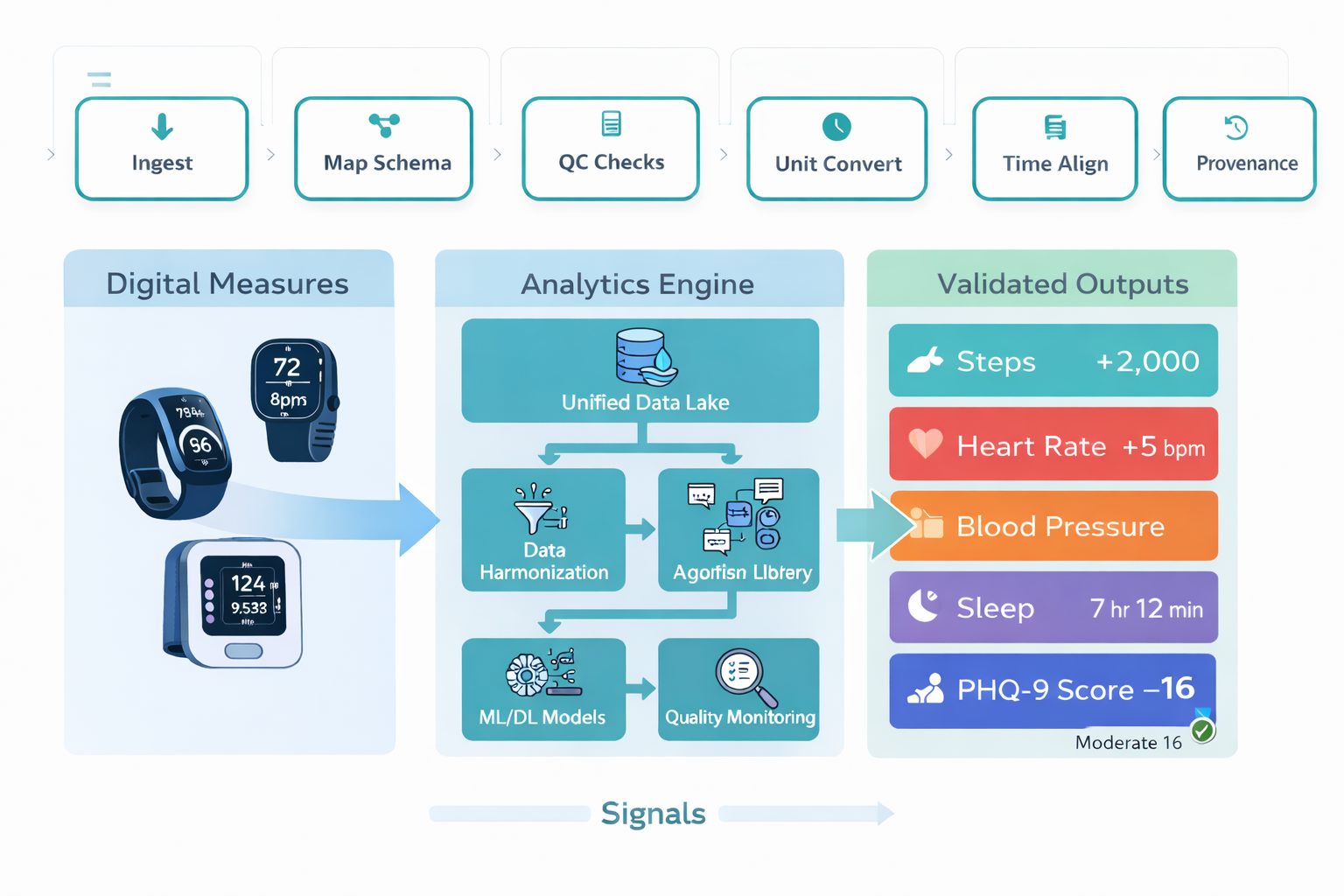
Digital measures rarely fail because the sensors fail. They fail because no one operationalizes the devices.
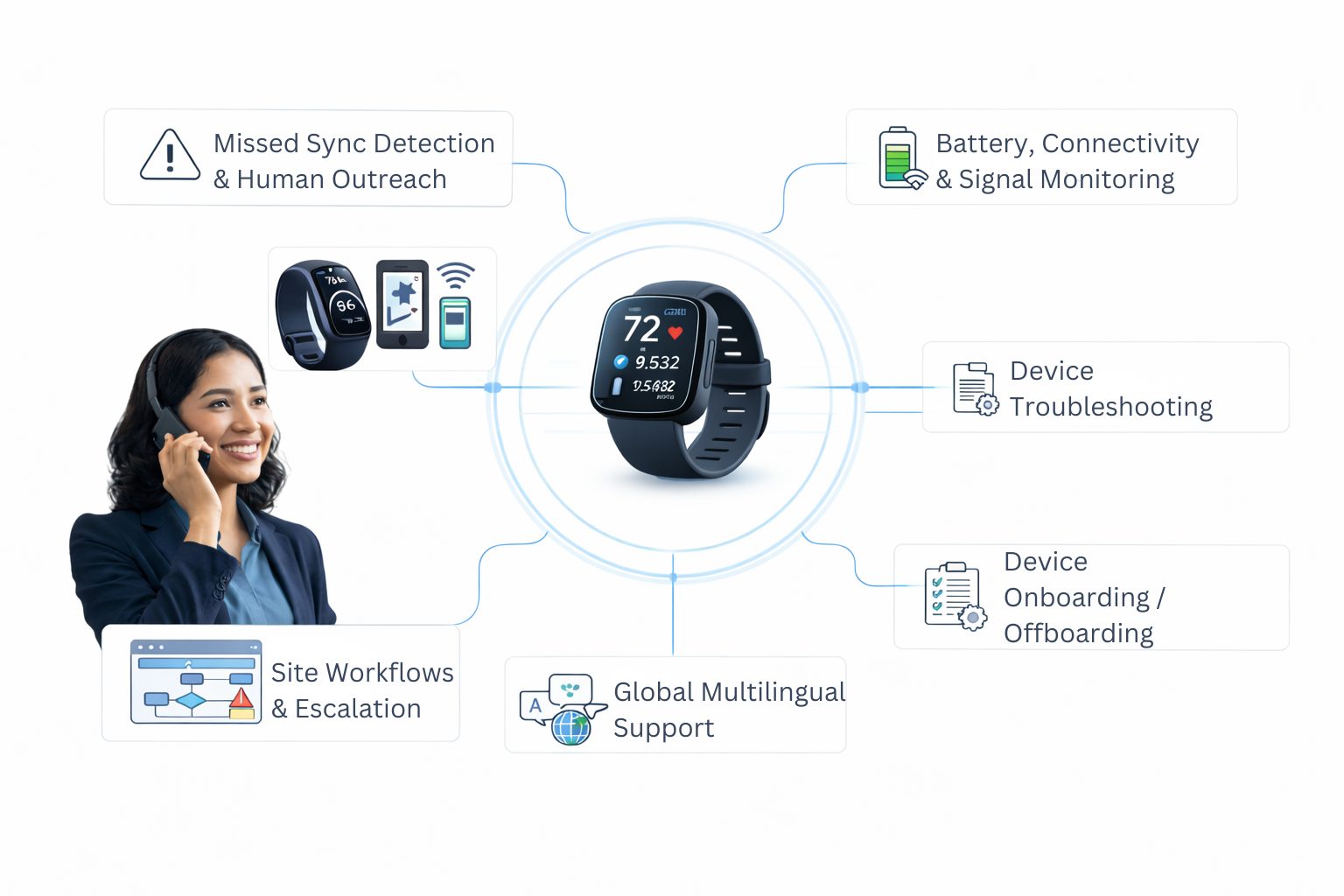
Connect any wearable or sensor, harmonize the signals into one clinical model, and keep the data clean with automated QC.
Medical wearables, consumer sensors, cellular devices, or BYOD, all in one platform.
Explore integration → 02HR, HRV, SpO₂, sleep, steps, and respiratory data normalized into a consistent clinical data model.
Explore harmonization → 03Outliers, missing samples, device drift, timestamp errors, and physiological anomalies caught early.
Explore signal QC → 04Harmonized endpoints exported directly to EDC, analytics pipelines, or submission packages.
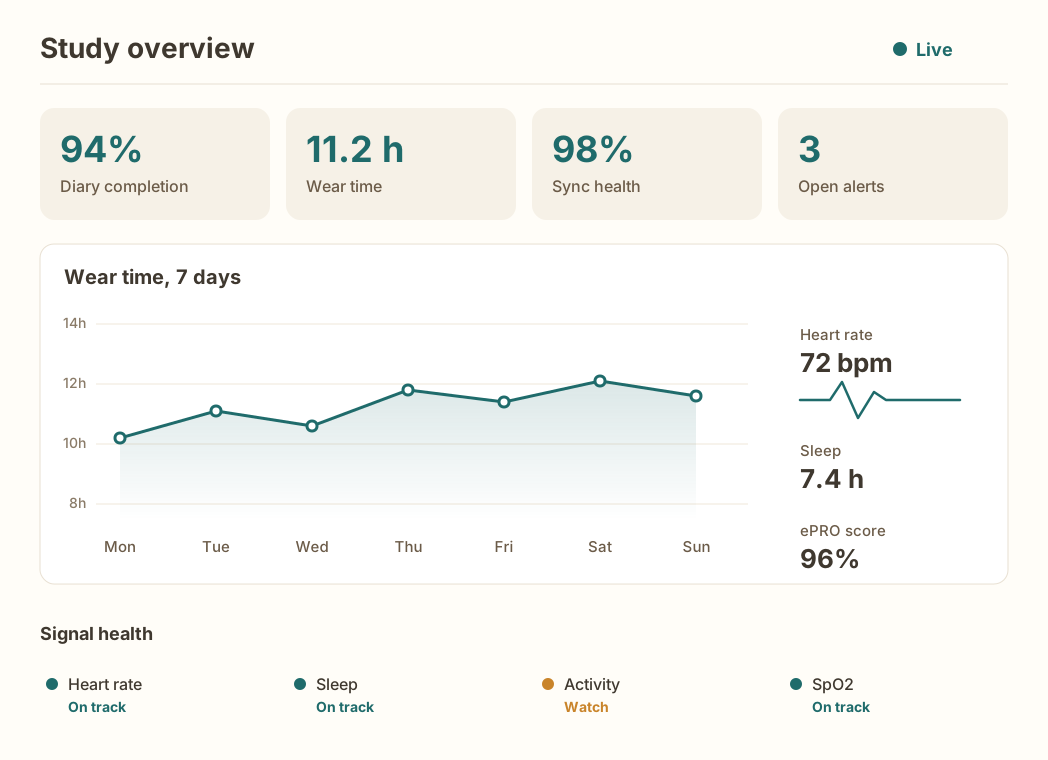
Explore APIs →Sponsors don’t just need wearables. They need digital measures that are accurate, reproducible, and clinically relevant, with live visibility in one clinical dashboard.
Every algorithm is documented, version-controlled, and aligned with FDA Digital Health Technology guidance, the DiMe V3 framework, and ICH E6(R3).
Heart rate, HRV, QT and PR intervals, QRS and ST analysis, and AFib burden.
Time in, above, and below range, GMI, glycemic indices, and variability measures.
Cadence, stride length, distance, MVPA, sedentary time, METs, and energy burned.
Rest-activity rhythm measures plus configurable sleep staging.
Spectral analysis and filtering that prepare raw signals for measurement.
Signal statistics, outlier and change-point detection, and gait speed, asymmetry, and variability.
Heart rate, SDNN (HRV), pNN50, RMSSD, P-wave detector, QRS morphology analyzer, QT interval, T-wave detector, PR interval, ST segment analyzer, CV% of RR intervals, QRS estimator, AFib burden, AFib episodes, average HR during AFib.
High Blood Glucose Index (HBGI), Low Blood Glucose Index (LBGI), M-value, GRADE, Glucose Management Indicator (GMI), J-index, CONGA, Time Above Range (TAR), Time in Range (TIR), Time Below Range (TBR).
Running and walking cadence, running and walking stride length, stride length estimator, running and walking distance, MVPA (moderate-vigorous activity), sedentary minutes, activity bouts detector, activity classifier, step detector, ENMO calculator, METs calculator, active and basal energy burned, M10 / L5 RA, intradaily variability, interdaily stability.
M10 / L5 relative amplitude, intradaily variability (sleep), detrend signal, plus configurable sleep staging.
PSD calculator (power spectral density), FFT magnitude calculator, spectrogram calculator, Butterworth lowpass, highpass, bandpass, and bandstop filters, notch filter.
RMS calculator, signal energy, peak-to-peak, zero-crossing rate, standard deviation, coefficient of variation, array min/max, array average, interpolate missing values, normalize signal, median filter, moving average filter, Savitzky-Golay filter, Z-score and MAD outlier detection, change point detection (PELT), walking and running speed, walking and running asymmetry, walking and running variability.
Digital Health Technologies for Remote Data Acquisition (2024 final).
Verification, analytical validation, and clinical validation.
Data integrity, attributability, and version control.
Electronic records and signatures.
Compliance isn’t a reminder problem. It’s an operational one. Automated triggers catch issues instantly, and human outreach closes the loop.
The detail behind the approach, for teams evaluating wearables in depth.
Fit-for-purpose device strategies aligned to endpoint sensitivity, patient burden, and operational feasibility.
Steps, gait proxies, activity tolerance, and functional change.
HR, HRV, ECG (device-dependent), and blood pressure.
SpO₂, respiratory rate, and symptom-linked physiology.
Duration, efficiency, and staging where supported.
CGM, weight scales, and longitudinal trend analysis.
Skin temperature and longitudinal vital trends.
Delve is building a defensible pipeline for digital endpoints and AI-enabled study operations, focused on making sensor data submission-grade and reliable in the real world.
Device ingestion, telemetry, and QC. In production.
Signal harmonization and the measures library. In production and expanding.
Endpoint validation packs with gold-standard correlation and reproducibility. Active.
AI-assisted protocol mapping and risk flags. Active.
Post-market and real-world evidence workflows. Roadmap.
This approach supports cardiovascular, oncology, metabolic, respiratory, and chronic disease programs, and extends evidence generation across the full lifecycle.
Digital measures only matter if they are defensible, deployable, and supported at scale.
Fit-for-purpose validation and reproducibility checks for digital submissions.
Shipping, SIM activation, returns, replacements, and inventory management.
Support for both patient-owned and sponsor-provided wearables.
Technical, patient-facing, and site support teams available worldwide in 40+ countries.
Onboarding, troubleshooting, reminders, and missed sync recovery.
Hardware failures, low battery, and connectivity loss caught instantly.
Automated triggers plus human outreach keep evidence collection continuous.
Industry-leading adherence across global, multi-device clinical studies.
Delve runs 70+ validated digital-endpoint algorithms across 25+ devices on one harmonized data layer, then applies signal quality control to confirm the data is complete and usable. Raw sensor signal becomes a defensible digital measure rather than an unvalidated data feed.
Delve supports 100+ device and sensor types across modalities including ECG, glucose (CGM), activity, sleep, respiratory, and cardiovascular signals, via BYOD, provisioned, cellular, and non-app devices, so data collection does not depend on a participant managing an app.
An active signal quality control layer validates completeness, flags drift, and catches sync failures before data is lost, while Concierge-as-a-Service™ recovers wear-time in 120+ languages before participants disengage. Around 95% device compliance is sustained with this human-supported model.
Yes. Delve unifies wearable data with eCOA/ePRO, analytics, and concierge support in one platform, so wearable signal and patient-reported outcomes are managed together rather than across separate vendors.
Practical guidance on running wearable studies: compliance, signal quality, and device selection.
Wear-time, drift, and what to monitor when wearables drive your endpoints.
Read →Why wear-time decays, where it decays first, and the recovery playbook.
Read →A practical framework for choosing wearables that fit your study, your patients, and your endpoints.
Read →What changes when a wearable study runs months or years, and how to keep data continuous.
Read →The most common failure mode in wearable trials, and why dashboards alone don’t catch it.
Read →How signal QC protects endpoint integrity before, during, and after data lock.
Read →Honest, side-by-side evaluations scored on signal quality, validated algorithms, wear-time, and execution.
The 2026 landscape, scored on what actually decides endpoint quality.
Read →The dimensions that decide endpoint quality. Use it to compare any two platforms.
Read →Delve vs every major eCOA, DCT, and wearable platform, side by side.
Read →Get a live walkthrough of the unified platform behind sensors, endpoints, analytics, and engagement.
Book a demo Or try the 2-minute compliance calculator